July 13, 2026
The Islamic Revolutionary Guard Corps (IRGC) is Iran’s most powerful instrument for aggression and regional destabilization. Reporting directly to Supreme Leader Ayatollah Ali Khamenei, the IRGC operates independently of Iran’s regular military and has built a vast network of proxy militias, including Hezbollah in Lebanon and Hamas and Palestinian Islamic Jihad in Gaza. Through its elite Quds Force, the IRGC trains, arms, and directs these groups to carry out attacks against Israel and other U.S. allies. Beyond warfare, it controls key sectors of Iran’s economy and enforces the regime’s ideological agenda at home and abroad, making it a uniquely dangerous organization that blends military, political, and terrorist power.
Key Takeaways
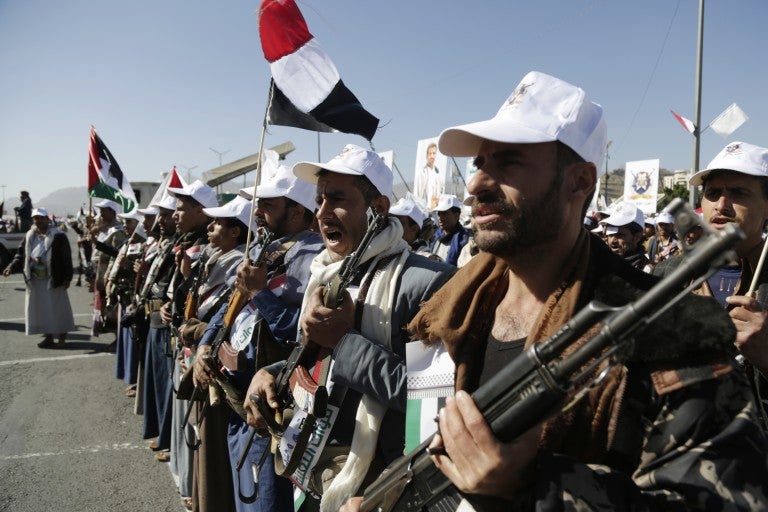
- The IRGC is the Iranian regime's primary tool for terrorism and regional aggression, directing and supporting proxy groups including Hezbollah, Hamas, Palestinian Islamic Jihad, and the Houthis.
- The EU's 2026 terrorist designation of the IRGC is a major milestone that strengthens efforts to isolate, sanction, and disrupt one of the world's leading sponsors of terrorism. The UK designated the IRGC under the new National Security (State Threats) Act 2026 on July 13, 2026.
- AJC has long advocated for the full designation of the IRGC as a terrorist organization, particularly in Europe, urging governments to pair designation with strong enforcement to weaken the regime's global terror network.
What is the Islamic Revolutionary Guard Corps (IRGC)?
Not to be confused with Iran’s traditional armed forces, the Islamic Revolutionary Guard Corps (IRGC) is a parallel military body formed during the Islamic Revolution in 1979 that protects the clerical regime and wields significant political, economic, and military power. It maintains its own air, land, and naval branches, commands the Basij religious militia used to crush internal dissent, and reports directly to Supreme Leader Ayatollah Ali Khamenei. It is estimated to have 190,000 active personnel. The IRGC’s elite Quds Force, responsible for extraterritorial operations, has cultivated and directed proxy militias such as Hezbollah in Lebanon, Kata’ib Hizballah and other groups in Iraq, and a broader network of Iran-aligned armed factions across the Middle East
The IRGC, through its Basij militia, plays a central role in Iran’s repression of domestic protests, including the most recent protests in late 2025 and early 2026. The U.S.-based Human Rights Activists News Agency (HRANA) said at least 6,373 people — of whom 5,993 were protesters — have been killed, warning that many more are feared to have died in the unrest.
It also plays an essential role in Iran’s regional aggression. The Quds Force is the IRGC's paramilitary and espionage unit that heavily influences allied terror groups throughout the Middle East, from Hezbollah in Lebanon to the Houthis in Yemen. Quds Force members have fought in support of Syrian President Bashar al-Assad during the country's civil war.
Who has designated the IRGC as a terrorist organization?
The Islamic Revolutionary Guard Corps (IRGC) has been designated a terrorist organization by the United States, which labeled it a Foreign Terrorist Organization in April 2019, including its Quds Force branch. The U.S. has been joined by Argentina, Canada, as well as Middle East allies Israel, Saudi Arabia, and Bahrain in designating the IRGC or its Quds Force as a terror group.
In an unprecedented move, the 27-member European Union formally designated Iran’s Islamic Revolutionary Guard Corps as a terrorist organization at a meeting of EU foreign ministers on January 29, 2026. European Foreign Policy Chief Kaja Kallas underscored the gravity of the decision, writing on social media that, “Any regime that kills thousands of its own people is working toward its own demise.”
“This designation is not symbolic. It is a decisive, long-overdue political act that sends a clear, unmistakable message that Europe, now united with governments around the world, will not tolerate terror,” said AJC CEO Ted Deutch.
AJC has long urged European leaders to make this designation, including through direct advocacy across the continent. Anne-Sophie Sebban-Bécache, AJC’s Vice President for Europe, explains why this decision matters and what must happen next to ensure the designation leads to real enforcement, stronger counterterrorism measures, and greater protection for vulnerable communities.
On July 13, the UK designated the IRGC under the new National Security (State Threats) Act 2026. The UK also designated Harakat Ashab al-Yamin al-Islamiyya (The Islamic Movement of the Companions of the Right), which claimed responsibility for seven attacks on Jewish communities, journalists, and Israeli-linked targets across Europe—including the UK—between March and May 2026. Under the new designations, it is now a criminal offense to express support for either group, assist their UK-related activities, or accept benefits provided by them or on their behalf.
What does the EU terror designation mean for the world?
The EU’s designation of the IRGC is a major turning point that hampers the terror organization’s ability to operate on the continent. This decision will:
- Politically increase the Iranian regime’s international isolation and back the Iranian people’s fight for basic rights and dignity
- Strengthen global coordination against the Iranian regime’s destabilizing efforts
- Financially and materially weaken a major driver of global terrorism and Iran’s nuclear pursuits
- Leverage Europol/Eurojust to investigate and prosecute IRGC-directed criminal and terror activity
- Freeze IRGC assets and block its members from operating or fundraising across Europe
By sharply limiting the IRGC’s reach, the EU has delivered a powerful message: those who terrorize their own people and threaten global security will face consequences.
How has the IRGC threatened Israel?
The Islamic Revolutionary Guard Corps (IRGC) has posed a persistent and multifaceted threat to Israel for decades. Through its elite Quds Force, the IRGC has armed, funded, and trained proxy groups along Israel’s borders, including Hezbollah in Lebanon, Hamas and Palestinian Islamic Jihad in Gaza, and militias in Syria.
In addition to supporting proxies, the IRGC has directed and sponsored direct attacks against Israel. This includes rocket fire from IRGC-backed militias in Iraq and Syria, maritime attacks on Israeli-linked shipping in the Persian Gulf, and cyber operations targeting Israeli infrastructure. Most recently, during the June 2025 conflict, Israel directly struck IRGC leadership and infrastructure in Syria and Lebanon, killing senior Quds Force commanders responsible for coordinating attacks. These strikes highlighted both the scale of the IRGC’s regional presence and Israel’s determination to counter it. Through a blend of proxy warfare, weapons proliferation, terrorism, and direct military engagement, the IRGC remains one of Israel’s most dangerous and immediate threats.
How the IRGC Threatens the U.S. and Europe
The IRGC’s reach extends far beyond the Middle East, posing a clear threat to U.S. interests and European security. Through the Quds Force, it has orchestrated attacks on American personnel, diplomats, and civilians, including assassinations, bombings, and the use of proxy militias in Iraq, Syria, and elsewhere. The IRGC has also backed terrorist organizations such as Hezbollah and Palestinian factions, enabling attacks on Western targets from South America to Europe. Its cyber capabilities have targeted critical infrastructure in the U.S. and European countries, demonstrating that its threats are both physical and digital.
In January 2021, missiles fired by a U.S. drone destroyed the convoy of Qassem Soleimani, the then-commander of the Quds Force, who was in the process of arming Palestinian resistance groups to wipe out Israel.
In March 2022, the IRGC said it launched a second surveillance satellite into space, defying a UN Security Council resolution, and demonstrating that Iran has the technology necessary to achieve intercontinental ballistic missile capability.
In Europe, the IRGC and its proxies actively support networks that conduct fundraising, smuggling, and terrorist operations, including the shipment of advanced weapons and explosives. Hezbollah, for example, continues to carry out antisemitic attacks and plots across the continent, exploiting gaps in European enforcement. The IRGC’s aggressive missile and nuclear programs further increase global instability, while its use of front companies and sanctioned entities circumvents international law to finance terror operations. Collectively, these activities make the IRGC not just a regional threat, but a direct challenge to U.S. allies and the rules-based international order.
In August 2025, Amir Hayat-Moqaddam, a senior commander in Iran’s Islamic Revolutionary Guard Corps (IRGC), said that the Iranian regime has been developing long-range missiles for two decades that can reach Europe and potentially target U.S. cities, stating, “perhaps our next missile will hit Washington directly.” These statements come as tensions escalate between Iran, Western nations, and Israel amid ongoing sanctions and military confrontations, and as Iranian-backed proxies—the Houthis and Hamas—continue to launch missiles and drones at Israel.
What are some other key measures taken against the IRGC?
The IRGC is the only foreign state entity on the roster of 67 other militant factions on the U.S. State Department’s list of foreign terrorist organizations (FTOs). Declared a state sponsor of terrorism in 1984, Iran already faced sanctions, including restrictions on U.S. foreign aid, a ban on defense exports and sales, and other miscellaneous financial restrictions.
Since 2007, the U.S. Department of Treasury has targeted the IRGC for its connections to Iran’s human rights abuses, backing Iran’s ballistic missile and nuclear programs, and supporting Hezbollah and Hamas.
The designation in April 2019 imposed at least two new restrictions, according to Matthew Levitt, Director for the Reinhard program on Counterterrorism and Intelligence at The Washington Institute for Near East Policy. The U.S. can prevent terrorists from entering the country by denying visas to current and former members of a designated group. In addition, third parties – individuals, companies, and countries – can face criminal charges if they don’t comply with U.S. sanctions against a terrorist group.
The unprecedented designation of IRGC gave other countries the confidence to blacklist the IRGC and Hezbollah, another dangerous Iran-backed terrorist operation. Although the U.S. declared Hezbollah a terrorist organization in 1997, other countries had been reluctant. But since then, Germany, Lithuania, France, Serbia, Argentina, and Australia have designated Hezbollah a terrorist group in its entirety. Still, most of the 27 European Union countries distinguish between Hezbollah’s militant and political wings and limit the terrorist label to its militant activity. Levitt calls this fiction, given the group’s ongoing sponsorship of antisemitic terrorist attacks across Europe and around the world.
“As European law enforcement officials can attest, banning only part of Hezbollah has not worked,” said Levitt. “Hezbollah called the EU's bluff and has continued engaging in terrorist and criminal activities notwithstanding the ban of certain parts of the group. The only remaining question is what Europe is willing to do about it.”
How does Iran support Hamas and Hezbollah?
Iran has long been known to provide support to both Hamas and Hezbollah. Iran's support for these groups is part of its broader strategy to increase its influence in the region and counter the influence of Israel and the United States. It sees these groups as proxies that can carry out its interests and goals in the region, including opposing the West and calling for Israel’s destruction.
To support Hamas, Iran provides financial aid, weapons, and training. Hamas is based in Gaza, a Palestinian territory that is bordered by Egypt and Israel. Its border with Israel is under a security blockade, so Iran’s support is crucial for Hamas to maintain its military capabilities. Iran provides Hamas with rocket technology and expertise, including advanced training, which has enabled Hamas to launch rockets into Israel during conflicts.
As for Hezbollah, Iran has been its main supporter and patron since the terror group was founded in the early 1980s. Iran provides financial support, weapons, and training to Hezbollah. Iran has also been known to provide Hezbollah with rockets and other advanced military technology, which has allowed the group to launch attacks against Israel and maintain a significant military presence in Lebanon.