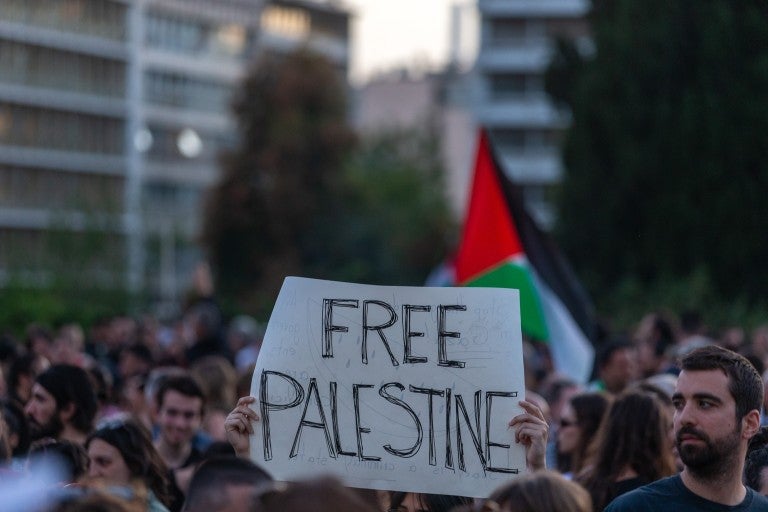
Learn how the phrase “Free Palestine” has become a prominent rallying cry in debates over Israel and the Palestinians—and how, in some contexts, it has been used to target, harass, and intimidate Jews or promote the elimination of Israel. From campus protests to Macklemore’s recent performances of “Free Palestine” and “Hind’s Hall,” the phrase has increasingly entered mainstream political and cultural discourse. This video explores its origins, different interpretations, and when its use can cross the line into antisemitism and incitement.
Free Palestine
While being detained, the murder suspect in the shooting outside the Capital Jewish Museum in Washington, D.C., an antisemitic attack, waved a red keffiyeh and began chanting “Free! Free Palestine!” Similarly, Mohamed Sabry Soliman, the 45-year-old suspect behind the Boulder, Colorado, arson attack on a peaceful pro-Israel rally that was urging for the release of hostages held by Hamas, also yelled "Free Palestine," according to the FBI.
From the Academy Awards red carpet to online comment sections, “Free Palestine” is a slogan commonly used by those advocating for Palestinian rights. In many contexts, it is intended as a call for justice, self-determination, and an end to occupation. However, the phrase is also used to call for the elimination of Israel and has been increasingly used to target, harass, and intimidate Jews—especially when weaponized in ways that go beyond criticism of Israeli policy and into explicit or implicit antisemitism.
The controversy surrounding rapper Macklemore illustrates how the phrase has become a flashpoint. During September 2026 performances opening for Ed Sheeran at MetLife Stadium in New Jersey, Macklemore repeatedly called for a “Free Palestine” and performed his protest song “Hind’s Hall,” which expresses strong support for Palestinians and opposition to Israel’s military campaign in Gaza. Jewish advocacy groups and others criticized the performances, arguing that his framing overlooked the October 7 Hamas attack and Israel’s security concerns.
The controversy also comes against the backdrop of Macklemore’s 2014 apology after a performance in which he wore what many viewers interpreted as an antisemitic caricature, including a large prosthetic nose and beard, while performing a song about inequality. Macklemore said at the time that the costume was intended to portray a stereotypical wealthy Jewish figure and apologized for the offense it caused. The episode has continued to shape criticism of his subsequent statements on Israel and the Palestinians.
Macklemore was subsequently removed from the remaining U.S. dates of Sheeran’s tour after venues told the tour’s promoter they would not allow concerts with him on the lineup. Sheeran later said the promoter and venues made the decision, not him, and said he wanted his concerts to remain spaces that bring people together.
Across the United States, Jewish institutions have been vandalized with the slogan “Free Palestine,” including synagogues, community centers, and kosher businesses. Jewish ritual objects have been defaced, and even simple holiday greetings posted online by Jews often provoke hostile replies invoking the same phrase. In these moments, “Free Palestine” ceases to be a call for a Palestinian state alongside Israel and instead holds Jews responsible for the acts of the State of Israel.
The phrase is not problematic when it is used as a call for justice, equality, and Palestinian self-determination and statehood. But when the phrase calls for the elimination of the State of Israel, and weaponized to harass Jews or justify murder, it crosses the line into political extremism and antisemitism.