December 9, 2025
Members of the City Council of Dublin, Ireland, last week pressed pause on a proposal to rename a park that, since 1995, has honored one of Ireland’s leading Jewish historical figure: former Israeli President and United Nations Ambassador Chaim Herzog.
Located in one of Dublin’s historic Jewish neighborhoods and adjacent to Ireland’s only Jewish school, the park is named after Israel’s sixth president, who was born in Belfast and raised in Dublin.
Why do some councillors want to change the park’s name?
Thirty years after the park was named – and in the wake of Israel’s defensive war against the Hamas terror group in Gaza – some council members are arguing that Herzog’s role in the military, as a senior intelligence officer, during the founding of the modern State of Israel renders him an unsuitable namesake for such a recognition.
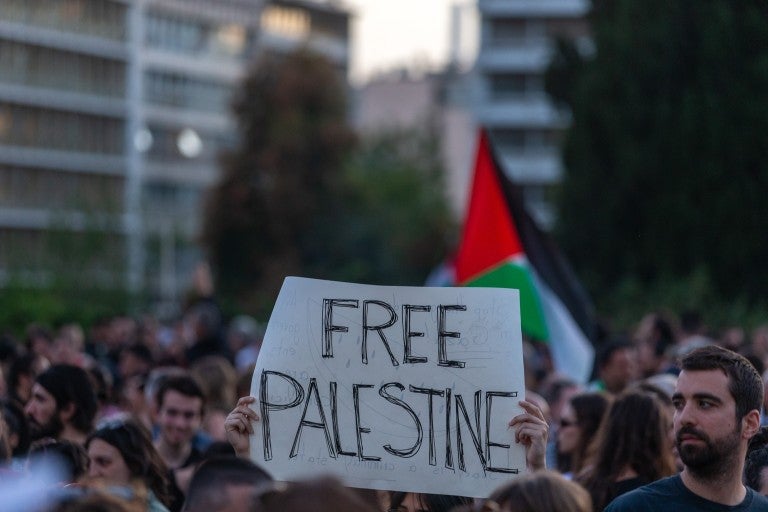
In the aftermath of the October 7 Hamas attacks on Israelis in which terrorists murdered 1,200 and kidnapped 251 others, and Israel’s subsequent response to defend itself against threats on seven fronts, these council members have suggested erasing Herzog’s name as a gesture of solidarity with Palestinians. One of the new names suggested is Free Palestine Park.
Who was Chaim Herzog?
The effort to remove Herzog’s name from the park symbolizes and risks erasing a key figure from Irish Jewish history who made immense contributions to the world at large.
As an Irish-born officer in the British Army, Herzog fought the Nazis in World War II and freed the concentration camp of Bergen-Belsen.
As ambassador to the United Nations in 1975, Herzog famously stood before the Assembly and tore apart a copy of the most anti-Israel initiative it ever undertook – a resolution declaring Zionism is racism. By defining Zionism as racism, all forms of which the UN previously had said should be eliminated, the resolution effectively said that Israel must be eliminated too. This “Zionism is racism” resolution is one of only two resolutions formally revoked by the UN General Assembly in its history. AJC advocated for 16 years until the resolution was repealed in 1991.
In 1983, he became Israel’s president, a largely ceremonial role now held by his son Isaac Herzog.
Does this debate conflict with Ireland’s own antisemitism guidance?
Yes. The language espoused by Dublin City Council members runs counter to the guidance of the International Holocaust Remembrance Alliance (IHRA) Working Definition of Antisemitism, which Ireland endorsed earlier this year. Though IHRA makes clear that criticism of Israel’s policies are not antisemitic, it also spells out when anti-Israel hate veers into antisemitism.
Here are several ways in which members of the Dublin City Council and segments of the general public have run afoul of the guidance provided by IHRA, abandoning any pretense of policy critique and descending instead into antisemitic vitriol that places Jews at risk.
Holding Jews responsible for actions of the State of Israel
While Israel is home to nearly half of the world’s Jews, the vast majority of Jews in the diaspora are not citizens of Israel and do not have a right to vote in Israel. That’s why, according to the IHRA Working Definition, holding Jews worldwide responsible for the actions of the State of Israel is not only illogical, it’s antisemitic.
Blaming today’s Jews for the policies of the Israeli government, endangers already beleaguered Jewish communities. In this particular case, Dublin City Councillors opposed to Israel’s defensive war against Hamas in Gaza, are taking an extra step and holding a Jewish historical figure responsible for the Jewish state’s contemporary policies, falsely accusing Herzog of crimes he did not commit. This not only targets today’s Jews as a collective, it targets all Jews throughout time, based on no knowledge of where they would have stood on today’s policies.
For example, when Chaim Herzog’s granddaughter, Dr. Alexandra Herzog, posted her concern on social media that the park in her grandfather’s old Dublin neighborhood park might no longer bear his name, Dublin City Council member Ruth Coppinger replied: “Your grandfather was a genocider in Palestine. #Herzog Park should be renamed #HindRajabPark.”
Chaim Herzog never systematically targeted a national, ethnic, racial, or religious group, for destruction. Ever. To weaponize that word against a Jewish historical figure is at best illogical, at worst, antisemitic.
As Alexandra Herzog later explained on AJC’s podcast, she has no objection to establishing a separate dedication to highlight the plight of the Palestinians. What she objects to is the erasure and replacement of her grandfather’s name.
“It's extremely problematic to remove a Jewish name to replace it by another group,” she said, noting that Jewish heritage should not be politicized. “We don't need to do that. We can recognize the realities and the lived experiences of both groups without having to erase one over the other.”
Dual loyalty
For millennia, the Jewish Diaspora has scattered around the world making civic, intellectual, and cultural contributions, encouraging pluralism, and fighting prejudice in their home countries, while still maintaining their Jewish culture and identity, including a deep connection to Israel.
Accusing Jewish citizens of placing the presumed priorities of Israel or Jews worldwide above the nation of their residence is antisemitism. Rarely, if ever, are individuals of any other religious, cultural, or national heritage questioned for loyalty to their current country of citizenship. Dual Loyalty is a bigoted trope used to cast Jews as the “other.” When a Jewish person is accused of being a disloyal citizen whose true allegiance is to Israel, that’s antisemitism.
For example, in response to the Herzog Park controversy, one Irish social media user wrote: "No such thing as an irish jew, your [sic] either Irish or a jew.”
Saying someone must choose between their nationality or their Judaism or casting doubt on Jews’ allegiance to their country of residence if they maintain a connection to Israel is antisemitic because it invokes the trope of dual loyalty.
Gaslighting
Who gets to define antisemitism? Certainly not those who perpetrate it. When the antisemitic experiences of Jews are questioned, that’s gaslighting—and it can be a form of antisemitism. Here’s how:
Dublin City Councilman Cieran Perry exemplified this type of antisemitism at last week’s meeting: “And I just highlight that equating opposition to genocide and the deliberate murder and starvation of children with antisemitism does a serious disservice to Jewish people actually suffering antisemitism and conflating anti-Zionism with antisemitism damages the battle against actual antisemitism and I would ask people who claim to be trying to tackle antisemitism, to take this on board.”
When only non-Jewish voices are called on, or take it upon themselves, to define antisemitism – while the lived experiences of Jews are dismissed or ignored – that’s its own form of gaslighting. Like any minority group, Jews must be believed when they describe the intolerance they face.
Denying the Jewish people their right to self-determination
Every nation has the right to self-determination — the ability to define their own identity, protect their community, and establish political sovereignty in their ancestral homeland. To deny this right only to the Jewish people, while recognizing it for all other nations, is a discriminatory double standard. This selective denial is precisely what the IHRA Working Definition of Antisemitism identifies as antisemitic.
Not only does it single out the Jewish people, it also erases Jewish history and indigeneity. The Jewish connection to the Land of Israel spans over 3,000 years — religiously, culturally, and historically– and there has always been a continuous Jewish presence on the land.
Recognizing this reality does not negate the Palestinian connection to the land; both histories are true, and a sustainable regional peace must recognize the historic ties of both peoples to the land.
To claim that Jews are foreign interlopers or “colonizers” is not a political critique; it is a rejection of documented Jewish history, identity, and peoplehood. Erasing a minority’s historical roots in their own homeland is discrimination - in this case it is antisemitic discrimination.
This particular act of antisemitism also reproduces historic antisemitic narratives. Claims that Jews have no right to collective identity or sovereignty echo myths that Jews are outsiders everywhere and do not belong in any land.
Dublin City Councilor Conor Reddy regularly denies the Jewish people the right to self-determination, saying time and time again that Israel has no right to exist: “The truth is, there never should have been an Israeli state just as there never should have been a Herzog Park.”
Zionism is Racism: Claiming that the existence of the State of Israel is a racist endeavor
Dublin City Councilor Conor Reddy claimed Zionism is racism, echoing the very dangerous falsehood that Chaim Herzog condemned before the UN in 1975. (The UN resolution making that claim was rescinded in 1991.)
"The charges of historical erasure there, what’s brought to mind for me is the villages of Lidha, Inwaz, Ascalan, places that have lost their name to history because of the role that Com Herzog played in ethnic cleansing, in genocide, in racism, and apartheid. I don’t think we can honor such a person in our city," Councillor Conor Reddy declared.
There is nothing inherent in Zionism that contradicts support for Palestinian self-determination; many Zionists advocate for Palestinian statehood. Zionism is the Jewish national liberation movement, aimed at reestablishing a homeland where Jews are culturally, historically, and religiously connected.
Labeling Zionism as racism has roots in the Soviet Union and antisemitic texts like the Protocols of the Elders of Zion, which falsely claimed Judaism promotes racial superiority. This distortion ignores the true meaning of being “chosen” in Judaism, diminishes the diversity of Jewish life in Israel and worldwide, and falsely suggests that Jews alone lack a right to self-determination.
Puppet master
When Dublin City Councilor Cieran Perry defended removing Chaim Herzog’s name from a local park, he didn’t just justify the decision—he echoed the medieval antisemitic “puppet master” trope, which imagines Jews secretly directing governments and manipulating political leaders behind the scenes.
That trope has existed for centuries, from Nazi propaganda to modern claims that Jewish or Israeli “lobbies” control global events. Perry’s remarks fall directly into that pattern. While defining what he believed antisemitism is, he simultaneously claimed Irish officials were acting under Jewish instruction: "The disgraceful intervention of Micheal Martin and others … I would classify that as a mountain of political interference in the business of a local authority. The optics would appear to show these senior Irish politicians carrying out the instructions of the Israeli lobby and it’s very hard to argue with that view when we see the actual result."
Portraying Irish leaders as controlled by “hidden Jewish power” isn’t a critique—it’s a conspiracy. That such a tiny community—0.2% of the world’s population—can still be cast as omnipotent puppet masters reveals how deeply rooted and dangerous these antisemitic myths remain, with real consequences for Jews worldwide.
Jewish lobby and spreading lies of Jewish control and power
While some people use “Jewish lobby” and “Israel lobby” interchangeably with no antisemitic intentions, the phrase “Jewish lobby” serves as a dog whistle for those who believe Jews control politics and have a “Jewish agenda.” So when “Jewish” or “Zionist lobby” is purposefully invoked to describe Jewish control of a political body such as a city council, that is antisemitism.
“This was a full-court press by the Zionist lobby and they think they win it," said councillor Ciaran Meachair. "They will not win this.”
There is no one “Jewish lobby” that speaks for the Jewish community. Just like every lobbying and interest groups in the U.S., Europe, and Ireland, individual Jewish groups advocate for various missions and causes.
Councillor Pat Dunne insisted that the Israeli military also applied pressure on the government to table the vote.
“We wouldn’t be having this discussion if there hadn’t been a call from the Secretary General," Dunne said. "I’m further convinced that whatever phone calls was made to our CEO and to other officials probably emanated from Israeli intelligence forces attached to the Israeli Defence Force because they’re active … in every issue in relation to Palestine. Trace it all the way back…and you’ll find that’s the source.”
Claiming that Israel interfered and has always interfered in international affairs amplifies the trope of Jewish control and power. That is antisemitic.
Holocaust denial
Saying that Jews as a people or Israel as a state invented or exaggerated the Holocaust or any of the methods used by the Nazis and their collaborators to carry out the genocide of the Jewish people is antisemitic. Full stop.
Yet this hasn’t stemmed the vile stream of Holocaust denial and distortion that has flooded social media since the debate over Herzog Park began. In one response to Chaim Herzog’s granddaughter, a social media user posted this remark:
And the denial doesn’t stop there. Some individuals now question the death toll and firsthand accounts of the October 7, 2023, terror attacks carried out by Hamas against Israel, an effort that appears intended not to uncover truth, but to exonerate the perpetrators and blame the victims.
Have Dublin councillors crossed the line before?
In fact, the anti-Israel hate and actions of today, often framed as policy critiques, frequently cross that line and mask contemporary antisemitism. A review of council meeting recordings and social media activity since October 7, 2023, show that, in the years leading up to the controversy surrounding Herzog Park, some members of the Dublin City Council and segments of the Irish general public have crossed the line from legitimate criticism of Israel into antisemitism, according to IHRA
Dublin Council member Reddy, who openly denies Israel’s right to exist, called October 7, 2023 – the deadliest attack on Jews since the Holocaust – a “beautiful” act of resistance.
Embracing the massacre and kidnapping of civilians in their homes and calling it beautiful is not only antisemitic. It is barbaric.
As antisemitism surges in Ireland and elsewhere around the world, American Jewish Committee (AJC), the global advocacy organization for the Jewish people, has been tracking it in all its forms and its many sources.
Learn more about when anti-Israel statements become antisemitic here. AJC’s Call to Action Against Antisemitism in America provides a sector-by-sector guide for how all of society can understand, respond to, and prevent antisemitism. For more information about antisemitic terms and tropes or how some frequently used words and symbols can become antisemitism depending on the context, check out our Translate Hate glossary.