April 16, 2026 — Cincinnati
This column originally appeared in the Cincinnati Enquirer.
In a democracy, debate over war is not only legitimate − it is essential. Americans should ask hard questions about military action, especially when the stakes include civilian lives, global stability, and the security of our allies.
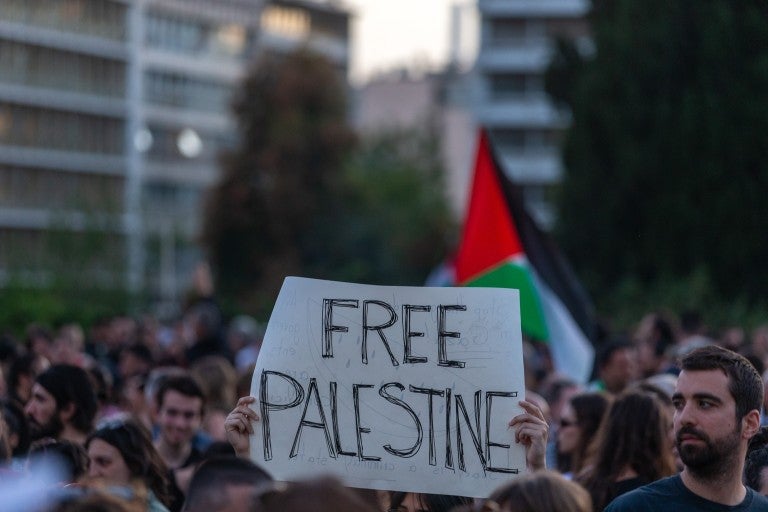
But what we are witnessing in the public conversation about the war with Iran is something more troubling: frustration about a conflict in the Middle East 6,000 miles away morphing into hostility toward Jews right here at home, from antisemitic tropes leveled at Jewish Congressman Greg Landsman, to an assailant who rammed his car into a suburban Detroit synagogue and exchanged gunfire with security personnel before taking his own life.
That rhetoric is not courageous dissent. It is ideological laziness. And too often, it incites antisemitic violence. Given that, it is not surprising that American Jewish Committee’s State of Antisemitism in America 2025 Report found that 91% of American Jews feel less safe as a Jewish person in the U.S. due to violent attacks in the past year, including the torching of Pennsylvania Gov. Josh Shapiro’s home and the murder of two Israeli embassy staffers outside the Capital Jewish Museum in Washington, D.C.
Across parts of the political spectrum, conspiracy theories about Jewish influence in American foreign policy have resurfaced. Commentators and influencers speak loosely about a “Zionist war machine” or suggest that American policy toward Iran is dictated by Israel or Jewish Americans.
These narratives are not new. They echo some of the oldest antisemitic myths − the idea that Jews secretly manipulate governments and drive nations into conflict.
Americans can and should debate whether military action against Iran is wise or necessary. But reducing complex national security decisions to “Jews pushing America into war” is not analysis. It is scapegoating.
Iran’s hostility toward the U.S. and its allies did not begin this week. Since the 1979 Islamic Revolution, the Iranian regime has sponsored terrorist organizations, supported proxy militias across the Middle East, targeted American military personnel, and pursued nuclear and missile capabilities.
Many of Iran’s Arab neighbors have increasingly formed security and economic coalitions with the U.S. and Israel, seeking to protect themselves from attacks and regional destabilization by the Iranian regime.
Equally misleading is the claim that the U.S. acts in the Middle East mainly on behalf of Israel. American engagement in the region has always been driven by U.S. strategic interests: countering terrorism, preventing nuclear proliferation, protecting global economic stability, and supporting allies in a volatile region.
Israel is an ally in those efforts. It does not dictate American policy.
There is nothing antisemitic about opposing war with Iran. Many thoughtful Americans have serious concerns about escalation and regional instability.
But policy disagreements cannot devolve into the demonization of a people. American Jews are increasingly worried about that and have responded accordingly. The AJC report found more than half (55%) of American Jews changed their behavior in the past year out of fear of antisemitism.
History shows that conflict in the Middle East often leads to spikes in antisemitic rhetoric and attacks against Jewish communities far from the battlefield. Jewish Americans should never be held responsible for decisions made by governments in Washington, Jerusalem, or Tehran.
Nor should Muslim or Iranian Americans face hatred because of the actions of Iran’s regime.
We should demand clarity from our elected leaders and vigorously debate the war with Iran. But blame for complex global conflicts must never be placed on an entire people or those advocating for a strong U.S.-Israel relationship. Doing so weakens the very democratic principles we claim to defend.
Justin Kirschner is Director of AJC Cincinnati