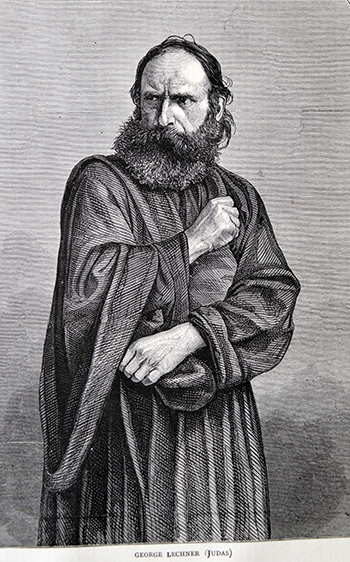
Oberammergau Passion Play: A Brief History
In the Context of Christian-Jewish Relations
Passion plays, originating in Europe in the 12th century, have a long history of virulent anti-Judaism. These theatrical performances of Jesus's Passion were often filled with medieval anti-Jewish tropes, depicting the Jews of the first century as greedy, bloodthirsty, devilish (including with horns), and exclusively concerned with the legalistic elements of religion. Most importantly, the plays often explicitly or implicitly charged the entire Jewish people with deicide, which sometimes served as a mobilizing force for the Christian audiences to violently attack their Jewish neighbors, especially during Holy Week.
The Oberammergau Passion Play of Bavaria, Germany, was particularly excessive in its negative portrayal of Jews and Judaism. The play was dominated by classic medieval anti-Jewish tropes. Additionally, Oberammergau’s tableaux vivant (living images) used Old Testament stories, scattered throughout the play, that were portrayed as superseded by New Testament stories.
According to Oberammergau village tradition, the Oberammergau Passion Play was first performed in 1634, as the fulfillment of a vow made by the townspeople. In 1633, Oberammergau was struck with the bubonic plague, and many people died. The townspeople vowed that if the deaths would stop, they would perform a Passion play every ten years to show their appreciation for God. The plague ended, and the townspeople fulfilled their vow. In 1680, the decennial schedule was fixed to the turn of decades (1680, 1690, etc.), and in 1899, when a railroad line was constructed between Oberammergau and the rest of Europe, the play became an attraction for foreign visitors as well.
Today, half a million people view the play during each decennial season. Additionally, Passion plays all over the world look to Oberammergau as a leader in the field and design local Passion plays with Oberammergau inspiration.
A notable attendee of the Oberammergau Passion Play was Adolf Hitler, who saw the play in 1930 and 1934, during its 300th year anniversary season. Following the play’s 1934 performance, Hitler proclaimed, “Never has the menace of Jewry been so convincingly portrayed.”
Even after the Holocaust, the text of Oberammergau was not immediately revised. However, the proclamation of Nostra Aetate in 1965, which positively transformed Catholic attitudes towards Jews and Judaism, put the unreformed play at odds with the Church, which meant that the play could no longer receive the missio canonica, or official Church blessing. Nostra Aetate rejected the idea that the Jews had been abandoned by God, and therefore the supersessionism in the play was no longer acceptable within mainstream Catholicism. Additionally, Nostra Aetate stated that Jews could not be held collectively responsible for Jesus's death, which ran counter to Oberammergau’s depiction of the Jews, of all generations, as guilty of deicide. Change was needed.
At the same time, and bolstered by Nostra Aetate, American Jewish groups began the fight to reform Oberammergau. Under the leadership of its Director of Interreligious Affairs, Rabbi Marc H. Tanenbaum, AJC submitted a report to German government authorities and church leaders detailing the problematic issues within the 1970 script. Seven years later, AJC led the first dialogue session between Oberammergau leadership and Jewish activists. When many of the proposed revisions were not carried out in the 1980 performance, Tanenbaum publicly declared Oberammergau as the “international capital” of antisemitism. Tanenbaum’s successor, Rabbi A. James Rudin, attended the 1984 performance of the play, and published an op-ed in The New York Times calling out Oberammergau as “unmistakably antisemitic,” in an attempt to push the townspeople to revise the play.
As a result of these and other efforts, real change to Oberammergau’s script, staging, and costumes began to occur in 1990, when Christian Stückl and Otto Huber took over as the directors of the play. At that point, the town committee did not allow Stückl to make significant changes to the script, but he was able to place greater blame for Jesus's death on the Roman prefect, Pilate. In past iterations, Pilate had only agreed to Jesus's crucifixion because he was coerced by the Jewish priest, Caiaphas, and the Jewish masses.
For the 2000 performance, Stückl and Huber revised the script and staging extensively. In this version of the play, Jesus's Jewishness was highlighted. For instance, he wore a kippah (Jewish head covering), was referred to as “Rabbi,” and prayed in Hebrew. Additionally, in this script, Judas betrayed Jesus for political reasons, while in earlier scripts he had done so for money. Pilate was presented more fully as the villain character, multiple supersessionist tableaux vivants were replaced by more positive biblical scenes, and the infamous line from Matthew that charged Jews in every generation with Jesus's death (“We take his blood upon us and upon our children”) was completely removed from the play.
Notwithstanding the progress, AJC remained committed to addressing the play’s lingering anti-Jewish tropes through constructive engagement. The current AJC Director of Interreligious and Intergroup Relations, Rabbi Noam Marans, and others, worked closely with Stückl before, during, and after the 2010 production. In the weeks before the premiere of the 2010 Passion Play, AJC, in partnership with Germany Close Up, brought a group of young American Jewish leaders to Germany in order to engage in critical discussions about the play within the wider contexts of German history, German Jewry, and Jewish-Christian relations. The ten-day trip centered on conversations with the Passion Play’s directors, organizers, and actors; it also included a seminar with theology students at Humboldt University in Berlin, a visit to the Sachsenhausen concentration camp, a meeting with German Catholics and Protestants as part of Ecumenical Church Day in Munich, and, of course, a viewing of the Passion Play itself.
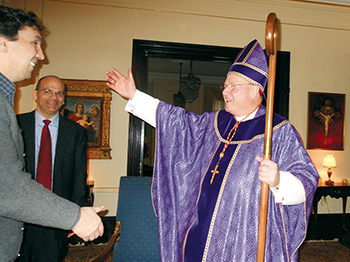
In July 2010, AJC further heightened its involvement with the Passion Play by hosting a joint Catholic-Jewish leadership journey to Oberammergau. Archbishop Timothy Dolan of New York, who served as the moderator of Jewish affairs for the United States Conference of Catholic Bishops, joined AJC’s director and associate director of Interreligious and Intergroup Relations, Rabbis Gary Greenebaum and Noam Marans, in attending a performance of the Passion Play and engaging in critical dialogue with the director and assistant director of the Play. Father Dennis McManus, assistant to the Archbishop, also joined the group. These AJC missions are now landmarks for constructive interfaith approaches to addressing the historically anti-Jewish aspects of the Oberammergau Passion Play.
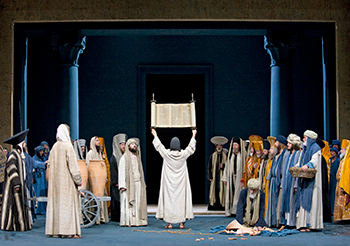
The most dramatic addition to the 2010 version was a new scene featuring Jesus holding aloft an open Torah (facsimile), while all the Jewish characters on stage sing a newly composed rendition of the Shema, Judaism’s central prayer. The “Jewishness” of Jesus and his followers was further emphasized in the 2010 production, and the struggle between Jesus's camp and the other Jews was more vividly portrayed as an internal Jewish matter rather than a theological battle between Judaism and emerging Christianity.
Progress has happened at Oberammergau, but the process of constructive engagement and revision must continue. There are remaining concerns regarding the depiction of the power dynamic between the Jewish priests and Pilate; Pilate should be portrayed as more powerful than the priests, as the historical record reflects. There remain concerns about points within the play that do not properly reflect the divided Jewish views of Jesus's leadership, as well as some of the tableaux vivants that remain supersessionist. It is therefore important that attendees educate themselves on the history of Oberammergau, the progress achieved, and the remaining sensitive lingering issues.
For the 2022 play, originally scheduled for 2020 but delayed by the pandemic, AJC convened an Academic Advisory Group to recommend, through ongoing dialogue with the play’s leadership, additional steps in this decades-long process, with a goal of ridding the play of any lingering anti-Jewish tropes. The Academic Advisory Group is led by Rabbi Noam Marans, AJC’s Director of Interreligious and Intergroup Relations, together with experts in Christian-Jewish dialogue, New Testament studies, German-Jewish relations, and the play’s history. We acknowledge the visionary leadership of Christian Stückl, the play's director, and others involved in the play’s production, who have been willing and interested in working with AJC and other Jewish and Christian experts on these matters over many years.
Positive change can be achieved with serious Christian-Jewish dialogue and collaboration. As Rabbi Tarfon states in Pirkei Avot (Teaching of the Sages), “It is not your duty to finish the work, but neither are you at liberty to neglect it” (3:16).


