American Jewish Committee (AJC), the global advocacy organization for the Jewish people, is offering guidance to university administrators on how to:
- prepare for the anniversary of October 7 on their campuses;
- proactively anticipate the needs of Jewish students;
- ensure there are safeguards and resources in place for them;
- proactively review security protocols for campus events; and
- develop programming that meets the institution’s high standards for accuracy and sensitivity.
AJC’s Center for Education Advocacy recognizes that every campus is different and has distinctive needs. We are here to help you thoughtfully address the needs of your school. Please contact us to discuss how we can assist.
Background
October 7th marks the date of the Hamas-perpetrated terror attacks in Israel, when 1,200 people were brutally murdered and 251 were taken into Gaza as hostages. As of January 26, 2026, no Israeli hostages remained, marking the first time since 2014 that Hamas holds no Israeli captives in Gaza.
October 7 represents the deadliest terror incident in Israel’s history, in which not only Israeli Jews, but also Muslims, Christians, Hindus, Buddhists, Israeli Arabs, and people from over 40 countries, including 49 Americans were targeted and killed.
For the worldwide Jewish community, October 7, 2023 also marks the most significant loss of Jewish life in one day since the Holocaust, and remains a painful open wound that may still directly impact Jewish students, faculty, and their families.
Be Alert and Aware
The October 7 attacks took place at the conclusion of the 2023 Jewish fall holiday season, during the joyous festival of Simchat Torah—a celebration marking the completion of the annual cycle of Torah reading and the beginning of a new one. That the anniversary occurs during a season of joy may deepen the emotional dissonance for Jewish students and families.
Be alert to the concerns of the Jewish community at a time when synagogues and other Jewish spaces are facing added risk and a need for increased security. It is now unfortunately routine for synagogues to be protected by armed guards, and it is important not to minimize the genuine security concerns that Jews face simply for attempting to live their lives openly as Jews. Administrators must ensure that the security needs of Jewish students are being met and that they remain safe and free from harassment when attending Jewish events or religious services on campus. If not done already, engage in comprehensive security reviews with law enforcement partners on and off campus that consider the kinds of shifting threats facing the Jewish community.
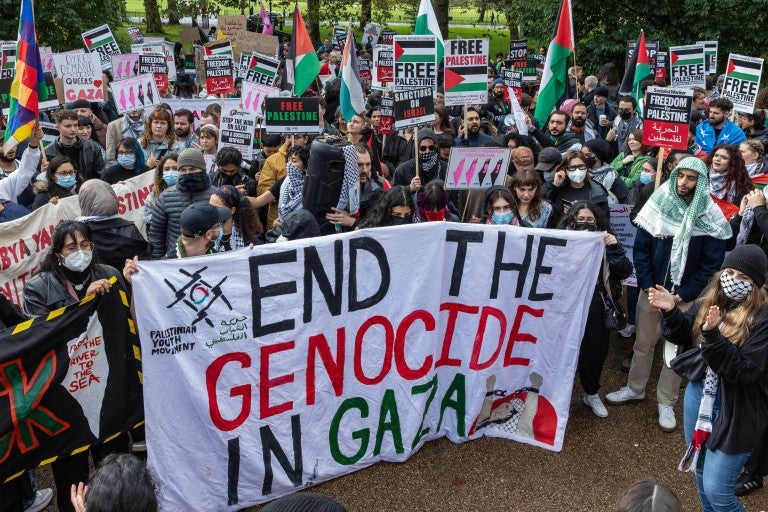
Be aware that many Jewish students have faced increasingly hostile rhetoric on their campuses because of their real or perceived connection to Israel and Zionism. Some of that rhetoric has included deeply problematic messaging about October 7 that denies or minimizes the extent of the attacks, or dehumanizes Israeli victims (“no innocent Israelis”; tearing down or vandalism of hostage posters; denial of sexual assault committed against Israelis). It has also included attempts to reframe the violence and terror of October 7 as justified resistance, decolonization, or liberation. While inflammatory or hateful speech may be permitted according to your campus’ speech codes, language that minimizes or denies the impact of October 7, vilifies Israel and Zionism, or engages in victim-blaming for the atrocities committed on October 7 will resonate painfully for many Jewish students, especially when such rhetoric appears in the spaces where they live and study.
Because of these sensitivities, ensure that your campus has resources in place to address the wellbeing and mental health of Jewish students at this stressful time in addition to the steps taken to bolster physical security. Make those resources known to your entire student community, and make sure that all students, including Jews and Israelis, have unfettered access to the support services they need with no gatekeeping or litmus tests.
Communicate with Care
In official and unofficial communications with students about the October 7 anniversary, avoid using terms with specific legal definitions (i.e.: terms such as “genocide” or “occupation”) or vague language that may unwittingly distort your messaging or dilute your support for Jewish students at this difficult time.
- We encourage you to use accurate statistics whenever you describe the events of October 7, which involved an unprovoked terrorist assault by Hamas on Israeli civilians that left roughly 1,200 people dead, including women and children, and more than 250 hostages kidnapped to Gaza, mainly civilians.
- There have been devastating civilian casualties on both sides of the Israel-Hamas war that followed from the October 7 attacks; however, it can be painful and triggering to Jews when October 7 victims are not given due recognition on their own terms, separately and distinctly from the casualties resulting from the ensuing war.
- Avoid incorrectly referring to those killed on October 7 as victims of war, military incursion, or occupation. These designations misread the sequence of events that resulted in the deaths of innocent civilians in southern Israel, and can unwittingly promote the narrative that there are no innocent Israelis.
- For similar reasons, messaging about October 7 should avoid comparative accounts of Palestinian deaths that ensued during the subsequent war. These deaths also deserve acknowledgment on their own terms, and should be addressed separately from messaging about the October 7 terror attacks.
If you have questions about how to navigate statements around October 7, we are happy to be a resource for you and your staff. Contact us for guidance or to learn more.
On-Campus Programs
For educational programming around October 7, it is important to ensure that any events bearing the university’s name and logo meet the university’s high standards for accuracy and sensitivity. Teach-ins and other programming focused on October 7 that receive official university approval should not become occasions for ideological indoctrination, ill-informed activism, the spread of misinformation, or shutting down dialogue around complex topics, even when they are painful. It is the university’s responsibility to ensure that educational programming focused on October 7 and other topics be open to all participants regardless of their viewpoint, and offer a balance of perspectives that draws on recognized sources of expertise. Administrators also have a responsibility to shut down events that fail to obtain university clearance or adhere to the university’s standards for educational programming. Administrators can and should make use of their own voices to speak out in opposition to unbalanced programming or any programming that endorses or excuses violence.
Be Mindful
Understanding the impact of October 7 on the Jewish community begins with being mindful of Jewish lived experiences and learning about the history of mass-violence perpetrated against Jews. AJC offers expert-led educational programming on the long history of anti-Jewish violence and its impact on Jewish collective memory. We also offer in-person educational programming for Resident Advisors, student activities supervisors, and leaders (both faculty and students) on navigating living together in a community, including guidance on fostering respect for the complexity of Jewish history and the diversity of Jewish traditions, culture, and identity.
Consider learning more about the Jewish community by attending an in-person off-campus event this year. We can help. Contact us to learn about opportunities in your region.