October 29, 2026
Israel’s October 27 national election left the country facing a difficult path to forming a government. With neither major bloc securing a majority in the preliminary count, coalition negotiations will determine who leads Israel moving forward.
Key Takeaways
- No clear path to a majority. Neither Prime Minister Benjamin Netanyahu’s bloc of right-wing and religious parties nor former IDF Chief of Staff Gadi Eisenkot’s bloc of centrist, secular, right-wing, and a left-wing party secured a majority.
- Coalition negotiations will decide who governs. The largest party does not automatically get to lead the government; the deciding factor is who can assemble a parliamentary majority.
- Turnout increased. Preliminary figures put Israeli voter turnout at approximately 77.7%, up from 70.6% in 2022.
- Ultra-Orthodox parties lost ground. The Shas and United Torah Judaism parties were projected to win 14 seats combined, down from 18 in 2022. Their reduced representation could affect negotiations over exemptions from military service for ultra-Orthodox men, a contentious issue as the IDF faces manpower demands.
- Arab parties gained seats. The Joint List and Ra’am parties are projected to win 19 seats combined. Their role in the next government remains uncertain, but their representation could influence debates over public safety, housing, and funding for Arab communities.
How Does Israel’s Electoral System Work?
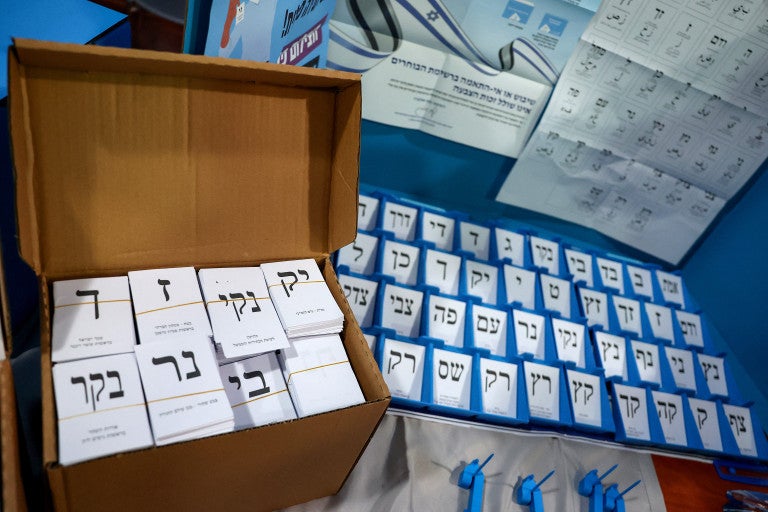
Israel’s 120-seat Knesset, Israel’s parliament, is elected through a proportional system in which voters choose parties, not a prime minister. Parties need at least 3.25% of the vote to win seats, and a government must command a majority of 61 lawmakers.
Because no party typically wins a majority alone, the president consults party representatives and assigns a lawmaker to form a coalition. The largest party’s leader is not automatically chosen; the goal is to find someone who can secure enough support to form a governing coalition.
What Were the Results of Israel’s 2026 Election? A Guide to the Main Parties
Israel’s October 27 election left no clear path to a governing majority. With all ballot boxes counted as of October 29, Prime Minister Benjamin Netanyahu’s right-wing and religious bloc was projected to win 53 seats, while the bloc led by former IDF chief of staff Gadi Eisenkot was projected to win 48. Arab-led parties were projected to win 19 seats.
Why does this matter?
Israel’s parliament, the Knesset, has 120 seats. A government needs the support of at least 61 lawmakers to govern. Since neither major bloc reached that threshold, party leaders must negotiate to build a coalition. Support from Arab-led parties could become important, although several parties in Eisenkot’s bloc ruled out including them in a governing coalition during the campaign.
The figures below are preliminary. Final official results are expected on November 4.
1. Netanyahu’s right-wing and religious bloc — 53 seats
This bloc is led by Likud, Netanyahu’s center-right party, and includes religious and far-right parties.
- Likud — 26 seats: Netanyahu’s center-right party.
- Shas — 7 seats: An ultra-Orthodox Jewish party led by Aryeh Deri.
- United Torah Judaism — 7 seats: An ultra-Orthodox Jewish party led by Ya’akov Asher.
- Otzma Yehudit — 7 seats: An extreme nationalist party led by Security Minister Itamar Ben-Gvir.
- Religious Zionism — 6 seats: A religious nationalist party led by Finance Minister Bezalel Smotrich.
2. Eisenkot’s centrist-led bloc — 48 seats
Led by Yashar, Eisenkot’s party, this bloc brings together centrist, right-wing secular, and center-left parties.
- Yashar — 21 seats: Eisenkot’s centrist party.
- B’Yachad — 12 seats: A centrist party headed by former Prime Minister Naftali Bennett.
- The Democrats — 8 seats: A center-left party led by former IDF Deputy Chief of Staff Yair Golan.
- Yisrael Beiteinu — 7 seats: A right-wing, secular nationalist party led by former Defense Minister Avigdor Lieberman.
3. Arab-led parties — 19 seats
These parties represent predominantly Arab constituencies but differ in their political and ideological approaches. Both also have Jewish members, including Ra’am, whose number two on its candidate list is Jewish. They have historically been less likely to join Israeli governing coalitions, with Ra’am joining in a short-lived government in 2021, but they could play a significant role in coalition negotiations.
- Joint List — 12 seats: An Arab-led alliance of Arab nationalist and communist parties led by Yousef Jabereen.
- Ra’am — 7 seats: An Arab-led Islamist party led by Mansour Abbas.
What Are the Domestic Issues at the Center of the Israeli Election?
Accountability for October 7. The Hamas-led massacre exposed major failures in Israel’s security and leadership. While most Israelis are in support of an official inquiry into the failures that led to October 7, the government and opposition remain divided over how an independent inquiry should be structured and appointed.
The ultra-Orthodox draft. With the IDF facing manpower shortages, pressure is growing to end broad exemptions from military service for ultra-Orthodox men. The next government will have to navigate this divisive debate.
Judicial reform. Supporters want elected officials to have greater authority, while critics warn that weakening judicial independence threatens checks and balances. The next government will help determine the reforms’ future.
Regional security. Netanyahu and Eisenkot agree that Iran, Hamas, and Hezbollah pose major threats, but differ on strategy. Netanyahu favors a more aggressive approach to Iran, including regime change, and has closely aligned with President Trump. Eisenkot emphasizes military pressure alongside diplomacy and stronger ties with Arab states. On Gaza, both oppose Hamas rule, but Eisenkot has backed implementing Trump’s peace plan, while Netanyahu has been more cautious.
How Could Israel’s Election Shape U.S. Relations, Iran, and the West Bank?
Iran and security cooperation: Both Netanyahu and Eisenkot view Iran as a major threat to Israel. Netanyahu has advocated preemptive military action and regime change, while Eisenkot has emphasized close U.S. coordination, maintaining Israel’s readiness to act militarily, and strengthening regional partnerships. Netanyahu’s close relationship with President Trump could shape coordination on any further military action against Iran.
West Bank and Palestinian policy: Netanyahu’s government has faced growing criticism over settlement expansion and its failure to effectively curb extremist settler violence, including from AJC. While Eisenkot has expressed support of Israeli settlements in principle, he opposes unauthorized settlement outposts and has pledged to combat extremist settler violence. However, like Netanyahu, he opposes Palestinian statehood.
Bipartisan support for Israel: Support for Israel has significantly weakened among Democrats, with disagreements over the war in Gaza, U.S. military aid and Netanyahu’s alignment with Republicans contributing to growing divisions. In 2026, 80% of Democrats and Democratic-leaning independents held unfavorable views of Israel, according to Pew Research Center. The next Israeli government will face pressure to address these concerns and help rebuild bipartisan support in Congress, even as the countries maintain close security ties.
The outcome matters for Washington. Netanyahu has decades of experience as prime minister and a longstanding relationship with President Donald Trump. Eisenkot, a former IDF chief of staff, brings extensive military and security experience. Whoever leads the next government will help shape Israel’s approach to regional security and its partnership with the United States.
U.S. aid: The current 10-year U.S.-Israel security assistance agreement runs through 2028, making its successor a key issue for the next government. Netanyahu has called for phasing out direct U.S. military aid over the next decade while maintaining close defense cooperation through joint investment and research. Eisenkot has emphasized repairing bipartisan support for Israel but has not publicly outlined a comparable plan to Netanyahu’s.
What are three key things Americans should know about Israel’s elections? Hear from Lt. Col. (Res.) Avital Leibovich, Director of AJC Jerusalem.
What Happens Next in Israel’s Election?
President Isaac Herzog will consult party representatives before assigning a head of a party to form a government. That leader has 28 days, with a possible 14-day extension. If efforts fail, another candidate may get a chance.
With neither bloc holding a majority, several scenarios remain:
- Another election: If coalition talks fail, Israelis could return to the polls. A new election could see lower turnout, particularly among Arab voters.
- A unity government: Opposition parties could join Likud in a broad coalition. But disagreements over who would serve as prime minister, which parties would be included, and whether to establish an independent inquiry into the October 7 failures could make a deal difficult.
- A minority government: Eisenkot’s bloc could form a government with outside support from Arab parties, without formally including them in the coalition. This would require some parties to reconsider campaign promises about whom they would work with.
FAQ: Israel’s 2026 Election
Who will be Israel’s next prime minister?
That will depend on coalition negotiations. Neither major bloc secured a clear majority in the preliminary count.
How does Israel’s election system work?
Voters choose parties to fill the 120 Knesset seats. A government needs the support of at least 61 lawmakers, and the president assigns a lawmaker the task of forming a government after consulting party representatives.
How long will it take to form a government?
The selected lawmaker initially has 28 days, with a possible 14-day extension. If that attempt fails, additional procedures may allow another lawmaker to try.
Could Israel hold another election?
Yes. If no lawmaker can form a government through the required procedures, another election is possible.
Who is Gadi Eisenkot?
Eisenkot is a former IDF chief of staff who leads the Yashar party. His campaign has emphasized accountability for October 7 and Israel’s security challenges.
Why does Israel’s election matter to the United States?
The next government will influence U.S.-Israel security cooperation, policy toward Iran and Palestinian issues, negotiations over future security assistance, and regional diplomacy, including efforts to expand the Abraham Accords.